Frequently Asked Questions
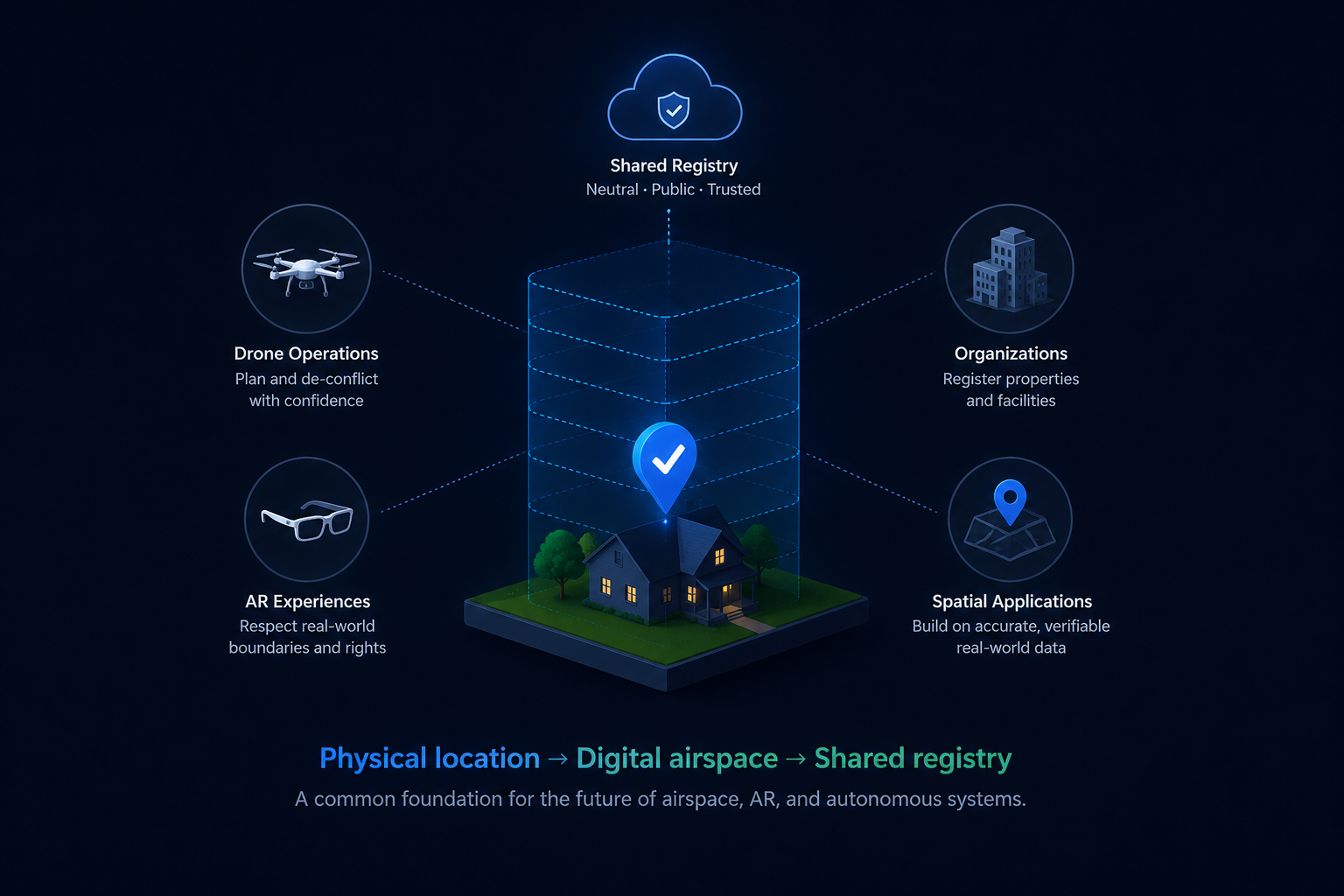
What is AirspaceRegistry.org?
A community-driven registry where individuals, businesses, and communities can register locations and express preferences regarding future interactions involving drones, augmented reality, and other spatial technologies.
Does registering a location create ownership rights?
No. Registration records community preferences and location information only. It does not create ownership interests, and preferences are not enforceable.
Are registry preferences enforceable?
No. Registry preferences are informational and voluntary — a metadata layer. They are not enforceable and are not permissions.
Why register early?
The next generation of technology will increasingly interact with real-world locations and airspace. Early participation helps ensure individuals, businesses, and communities have a voice as standards and practices evolve. Much as registering a domain name like yourname.com mattered in the early days of the web, establishing an early record for your location and its airspace preferences lets you take part as this real-world layer of the internet takes shape.
Is registration free?
Yes. Early participation in the community registry is currently free.
Does AirspaceRegistry.org own the founder's patents?
No. The founder separately owns an issued U.S. patent and multiple pending patent applications relating to spatial rights registration and management systems. While those intellectual-property rights may support the effort in the future, they remain separate assets and are not licensed or assigned to the registry merely because the registry exists.
Why compare this to DNS?
DNS became foundational infrastructure for organizing information on the internet. AirspaceRegistry.org seeks to become an early framework for organizing information about real-world locations and airspace interactions so that communities and future technologies can communicate more effectively.